
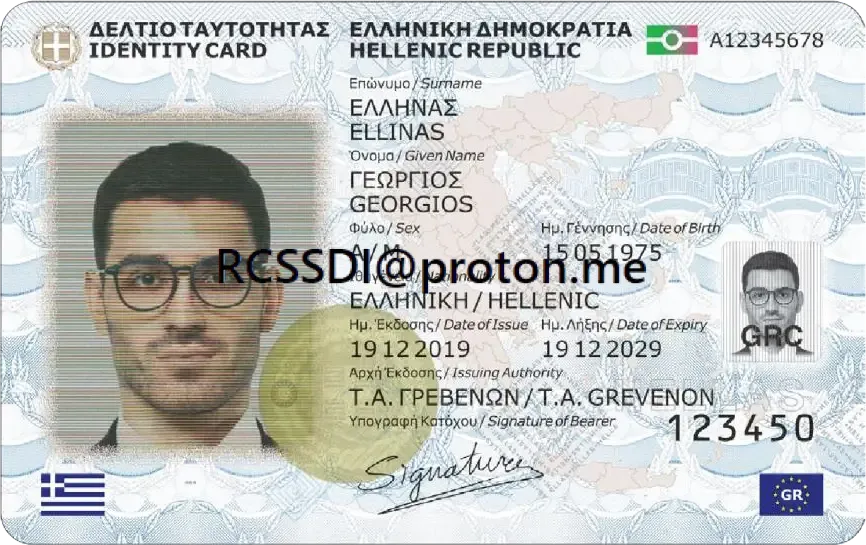
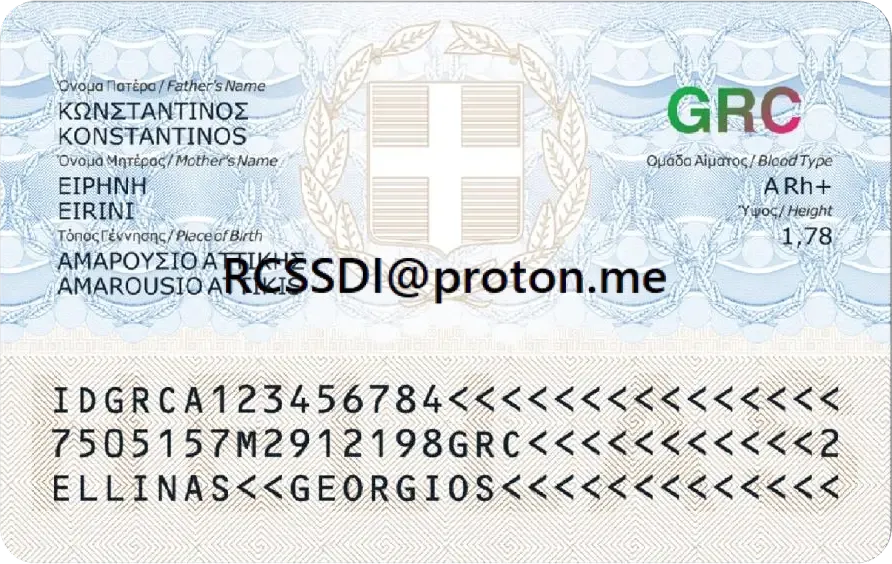
Buy EU-Greek National ID Cards Online with Security Features: Providing New Identity in European Union
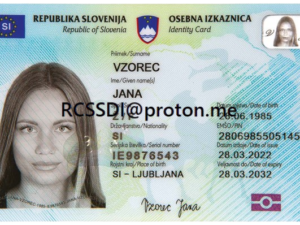
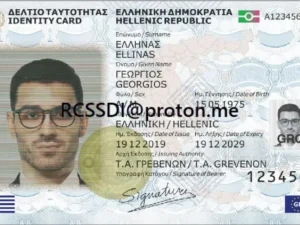
National identity cards are an essential part of identity verification systems across many European countries. Unlike some regions where identification documents are limited to passports or driver’s licenses, many European nations issue EU-Greek national ID cards online that serve as official proof of identity and citizenship.
These cards are widely used for everyday activities such as accessing government services, traveling within the European Union, opening bank accounts, and verifying identity in legal or financial transactions. Because they carry sensitive personal information and are frequently used as official identification, European national ID cards are designed with advanced security technologies to prevent fraud and counterfeiting.
Modern EU-Greek ID cards online combine biometric technology, durable materials, and sophisticated printing techniques to ensure authenticity and protect the identity of cardholders.
The Role of National ID Cards in Europe
National ID cards are widely accepted as the primary form of identification in many European countries. Citizens may use them instead of passports for travel within the European Union and the Schengen Area, depending on the destination.
In everyday life, these cards are commonly required for verifying identity when accessing healthcare services, registering for government programs, opening bank accounts, completing employment verification, and interacting with public institutions.
Because national ID cards are so widely used, governments must ensure they are highly secure and resistant to tampering or duplication.
To maintain strong security standards across Europe, many countries follow regulations set by the European Union regarding biometric identity documents.
EU Regulations for Secure Identity Documents
In recent years, the European Union introduced new regulations aimed at strengthening the security of national identity cards issued by member states.
These regulations require modern ID cards to include biometric identifiers, machine-readable features, and standardized security elements. The goal is to improve identity protection while ensuring compatibility with border control systems across the EU.
Under these regulations, most new European national ID cards must include biometric data such as facial images and, in some cases, fingerprint information stored on a secure electronic chip.
These improvements help prevent identity fraud and allow authorities to verify identity documents quickly and reliably.
Biometric Electronic Chips
Many modern European ID cards now include an embedded electronic chip, similar to the chips used in biometric passports.
This chip securely stores key information about the cardholder, including personal details, a digital version of the photograph, and biometric identifiers such as fingerprints in some countries.
When the card is scanned using specialized readers, the chip provides encrypted data that can be verified against the printed information on the card.
Because the chip uses encryption and digital signatures, it is extremely difficult for criminals to copy or manipulate the stored information.
Polycarbonate Card Material
European national ID cards are typically made from polycarbonate, a durable plastic material used in high-security identification documents.
Polycarbonate allows personal information and photographs to be laser engraved directly into the card layers, rather than printed on the surface.
This technology ensures that the information becomes part of the card structure itself. Attempts to alter or replace personal details usually damage the card, making tampering easy to detect.
Polycarbonate cards are also highly durable and resistant to wear, allowing them to remain secure even after years of daily use.
Laser Engraved Personal Data
Many European ID cards use laser engraving technology to place the cardholder’s personal information and photograph onto the polycarbonate card.
Laser engraving produces permanent images and text by burning the data into the card material. This process creates highly detailed images that cannot easily be erased or modified.
Some ID cards also include secondary or ghost images of the cardholder’s photograph as an additional security measure. These smaller duplicate images help authorities verify that the photograph has not been replaced.
Laser engraving significantly increases the security and durability of the document.
Holographic Security Elements
Holographic features are widely used on European national ID cards to prevent counterfeiting.
These holograms create reflective visual effects that change when the card is tilted or viewed from different angles. Some holographic designs include national symbols, government emblems, or repeating patterns unique to the issuing country.
Because holograms require specialized manufacturing equipment to produce, they are extremely difficult for counterfeiters to replicate accurately.
Security personnel can quickly check holographic elements to confirm whether an ID card is genuine.
Ultraviolet (UV) Printing Features
European national ID cards often include ultraviolet printing, which reveals hidden images and patterns when viewed under UV light.
These features are invisible in normal lighting conditions but appear when exposed to ultraviolet lamps commonly used by law enforcement and border officials.
UV designs may include symbols, numbers, or decorative artwork related to the issuing country.
The use of specialized UV inks makes these elements difficult to reproduce using ordinary printing technology.
Microprinting Technology
Microprinting is another important anti-counterfeiting feature found on many European ID cards.
This technique uses extremely small text printed in specific areas of the card. To the naked eye, the text often appears as a simple line or pattern, but it becomes readable when magnified.
Microprinting is difficult to replicate using standard printers, and counterfeit cards often display blurred or distorted text when examined closely.
Authorities can use magnification tools to verify these microprinted elements.
Machine-Readable Zone (MRZ)
Many European national ID cards include a Machine-Readable Zone (MRZ) similar to the one found in passports.
The MRZ contains coded characters that represent important information such as the cardholder’s name, nationality, date of birth, and document number.
Border control systems can scan this zone quickly to retrieve data and compare it with the information stored on the biometric chip.
This automated verification helps detect fraudulent or altered documents.
Tactile Security Features
Some European ID cards include tactile features, such as raised text, embossed patterns, or textured surfaces that can be felt when touched.
These features provide an additional layer of security because they require specialized manufacturing techniques.
Law enforcement officers can use tactile elements to quickly check whether an ID card is authentic during inspections.
Complex Background Patterns and Security Printing
European national ID cards also incorporate complex background patterns created using specialized security printing methods.
These patterns include intricate line structures, color gradients, and anti-copy designs that prevent accurate reproduction using scanners or standard printers.
If someone attempts to copy the card, these patterns typically become distorted or blurred, making counterfeit documents easier to identify.
Continuous Improvements in Identity Card Security
As identity fraud methods evolve, European countries continue to upgrade their national ID cards with new security technologies.
Recent improvements include stronger encryption for biometric chips, enhanced holographic elements, improved UV printing designs, and more durable card materials.
These updates help ensure that national ID cards remain reliable and secure forms of identification for citizens across Europe.
European national ID cards are highly sophisticated identification documents designed to protect personal identity and support secure travel within the European Union. Through the use of biometric chips, polycarbonate materials, laser engraving, holographic elements, ultraviolet printing, microprinting, and machine-readable zones, these cards incorporate multiple layers of protection against fraud and counterfeiting.
These advanced security technologies allow governments to maintain trust in their identity systems while ensuring that citizens can safely verify their identity in everyday life.
As technology continues to develop, European countries will likely continue enhancing their national ID cards to provide even stronger protection against identity fraud while supporting secure and efficient identification systems across the continent.
Reviews
There are no reviews yet.